

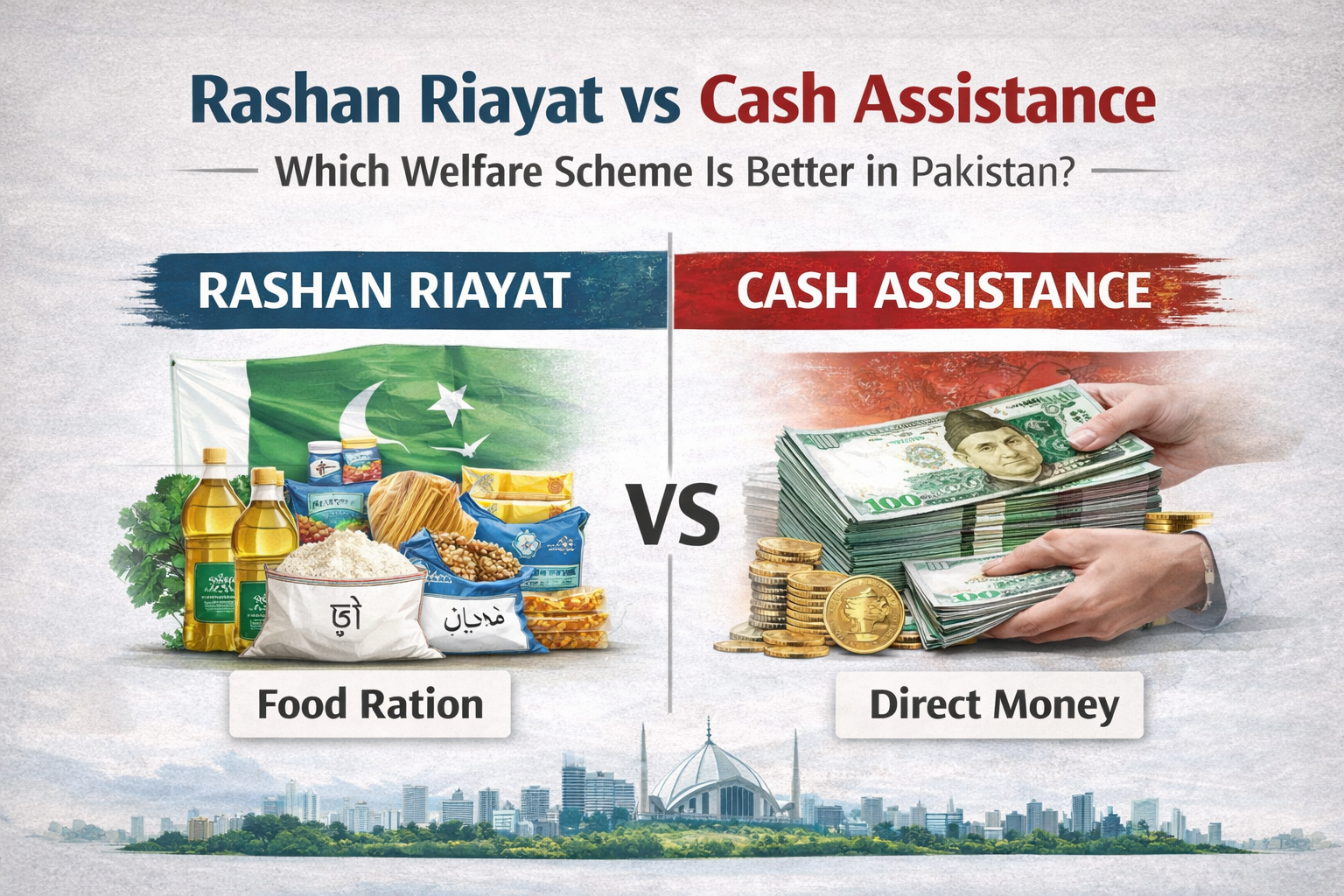
When governments try to protect poor households from inflation, they usually choose one of two tools:
- Rashan Riayat (subsidized food)
- Cash Assistance (direct money)
Both Rashan Riayat vs Cash Assistance
aim to help the same people.
Both use the same CNIC.
Both claim to reduce hardship.
Yet beneficiaries often ask:
“Which one is actually better?”
The honest answer is uncomfortable:
Neither is universally better. Each solves a different problem—and creates a different limitation.
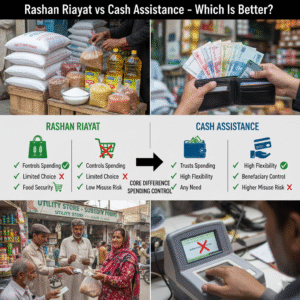
This article compares Rashan Riayat vs. cash assistance, explains how each works, who benefits more from which, and why governments keep switching between the two.
Also Read This
Ehsaas Kafalat Program – CNIC Check 8171, Payment Details & Women Suppor
What Is Rashan Riayat?
Rashan Riayat is a subsidy-based welfare scheme that provides essential food items at reduced prices through:
- Utility Stores
- Registered retailers
- Partner shops
Typical items include:
- Wheat flour
- Sugar
- Cooking oil
- Pulses
The benefit is restricted to food only.
What Is Cash Assistance?
Cash Assistance provides direct money to beneficiaries, usually through:
- BISP / Ehsaas Kafalat
- Emergency cash programs
- Bank or biometric payment centers
Cash can be used for:
- Food
- Rent
- Medicine
- Education
- Utilities
The government does not control how the money is spent.
The Core Difference (In One Line)
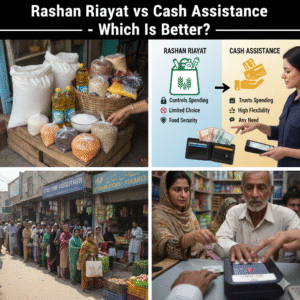
- Rashan Riayat controls spending
- Cash Assistance trusts spending
This single difference shapes everything else.
Rashan Riayat vs Cash Assistance – Quick Comparison
| Aspect | Rashan Riayat | Cash Assistance |
| Form | Subsidized food | Direct cash |
| Flexibility | Very low | Very high |
| Control | Govt-controlled | Beneficiary-controlled |
| Inflation Protection | Partial | Indirect |
| Misuse Risk | Low | Higher |
| Dignity | Lower | Higher |
| Coverage | Limited items | Any need |
| Market Impact | Distorts prices | Increases demand |
Both help. Both limit.
Also Read This
Advantages of Rashan Riayat
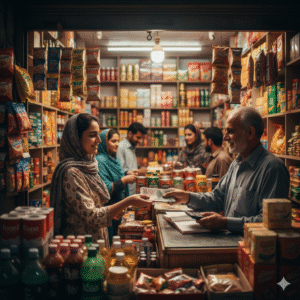
1. Ensures Food Security
Rashan Riayat guarantees:
- Basic food availability
- Minimum nutrition support
Even if cash is misused, food is still received.
This matters in extreme poverty.
2. Protects Against Food Inflation
By subsidizing staples:
- The government absorbs part of price increase
- The food inflation impact is softened
This is especially useful during price shocks.
3. Reduces Risk of Cash Misuse
Cash can be spent on:
- Non-essential items
- Debt repayment
- Family pressure
Rashan Riayat removes this risk by design.
4. Politically Safer for Govt
Food subsidies:
- Are visible
- Reduce public anger
- Signal “direct help.”
Governments prefer visible relief.
Disadvantages of Rashan Riayat
1. No Choice for Beneficiaries
Families cannot:
- Use subsidy for medicine
- Pay school fees
- Cover rent or transport
Hunger isn’t the only expense.
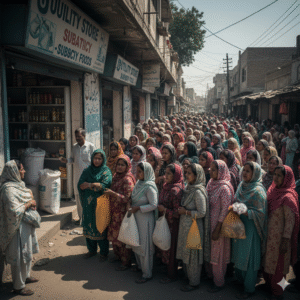
2. Quality & Availability Issues
Common complaints include:
- Poor quality items
- Limited stock
- Long queues
- Distant stores
Subsidy exists—access doesn’t always.
3. Does Not Address Non-Food Poverty
A family may eat—and still:
- Miss rent
- Skip medicine
- Drop children from school
Rashan Riayat treats one symptom, not poverty itself.
Advantages of Cash Assistance
1. Maximum Flexibility
Cash allows families to:
- Prioritize urgent needs
- Adjust spending monthly
- Respond to emergencies
Poverty is not uniform. Cash adapts.
2. Preserves Dignity
Cash:
- Avoids queues
- Reduces public exposure
- Feels less like charity
This psychological factor matters.
3. Supports Local Markets
Cash:
- Increases purchasing power
- Supports small shops
- Keeps money circulating
This helps the broader economy.
4. Administrative Simplicity
Cash programs:
- Are easier to scale
- Avoid logistics of storage and transport
- Reduce supply chain corruption
Less movement. More efficiency.
Disadvantages of Cash Assistance
1. Can Increase Inflation Slightly
More cash + same supply = higher prices.
If not controlled, cash can:
- Push prices up
- Reduce its own value
2. No Guarantee Money Is Used for Food
Cash can be diverted to:
- Debt
- Non-essential spending
- Family demands
Food security is not guaranteed.
3. Vulnerable to Biometric & Payment Failures
Cash assistance depends heavily on:
- Biometric verification
- Payment centers
- System uptime
Failures stop everything.
Which Is Better for Whom?
Rashan Riayat Is Better If:
- Household faces food insecurity
- The beneficiary struggles with cash management
- Inflation is sharply food-driven
- The government wants visible relief
Cash Assistance Is Better If:
- The household has diverse expenses
- Medical or education costs exist
- Markets function properly
- The beneficiary needs flexibility
Why Govt Uses Both (Not One)
Governments don’t choose because:
- Both serve different goals
- Neither solves poverty alone
- Budget and politics matter
Often:
- Rashan Riayat stabilizes food
- Cash assistance stabilizes households
Combination > replacement.
Why Beneficiaries Often Prefer Cash
Because:
- Poverty is complex
- Needs change monthly
- Control matters
People rarely ask for food.
They ask for choice.
Why Govt Often Prefers Rashan Riayat
Because:
- It limits misuse
- It’s visible
- It controls inflation optics
- It’s politically defensible
Governments fear cash leakage more than hunger statistics.
Common Myths
❌ “Cash assistance is always better.”
❌ “Rashan Riayat is useless.”
❌ “One should replace the other.”
Both are incomplete alone.
Frequently Asked Questions (FAQs)
Can a family receive both?
Sometimes, depending on phase and eligibility.
Does Rashan Riayat stop cash assistance?
Not automatically. They are separate tools.
Which costs the govt more?
Both are expensive—in different ways.
Which reduces poverty better?
Cash helps income poverty. Rashan helps food poverty.
Final Verdict
The question “Rashan Riayat vs Cash Assistance—which is better?” has no single answer.
- Rashan Riayat prevents hunger.
- Cash assistance restores choice.
One feeds the body.
The other supports life.
The real failure is expecting either one to fix poverty alone.
Relief is temporary.
Policy must be layered.
Rashan Riayat vs Cash Assistance → pillar comparison
↳ Link to BISP
↳ Link to Ehsaas Kafalat
↳ Link to Punjab Rashan Riayat
↳ Link to NSER Survey