
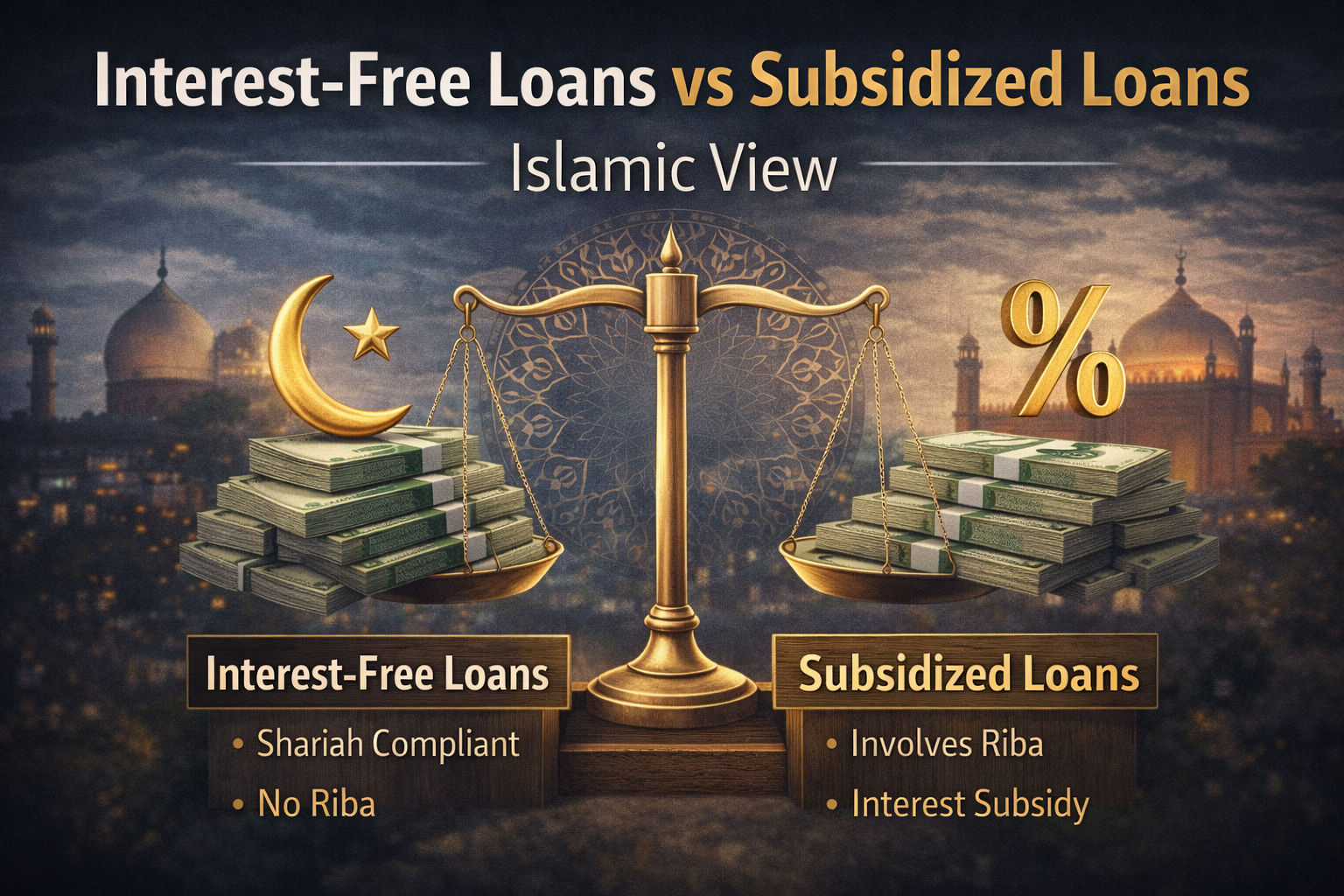
In Pakistan, government and private institutions often advertise two types of “Shariah-friendly” financing:
- Interest-Free Loans
- Subsidized Loans
Both are promoted as Islamically acceptable. Both are marketed to Muslims who want relief without violating Shariah.
But here is the uncomfortable truth:
Only one of these is inherently halal.
The other depends entirely on its structure.
This article explains interest-free loans vs. subsidized loans from an Islamic perspective, clarifies common misconceptions, and helps you understand which one is truly permissible—and why.
Also Read this
Islamic Foundation: What Makes a Loan Halal or Haram?

In Islam, the ruling on loans is clear.
Allah says:
“Allah has permitted trade and forbidden riba (interest).”
(Surah Al-Baqarah 2:275)
Any loan that requires extra payment over the principal because of time falls under Riba, regardless of:
- The amount
- The intention
- The name used
Islam judges reality, not labels.
Also Read this
Solar Panel Scheme vs Electricity Subsidy – Which Saves More?
What Is an Interest-Free Loan in Islam?

An interest-free loan in Islamic terminology is called Qarz-e-Hasan.
Key Characteristics of Qarz-e-Hasan
- Borrower returns exactly the same amount
- No markup, profit, or time-based increase
- No benefit conditional on the loan
- Given as help, not trade
Islamic Status
✔️ Unconditionally Halal
There is no scholarly dispute on this.
Also Read this
What Is a Subsidized Loan?

A subsidized loan is usually a conventional loan where:
- Interest exists
- Government pays part of the interest
- Borrower pays a reduced markup
To the borrower, it looks cheaper.
To Shariah, the question is different.
The Core Islamic Question
Does subsidized mean interest-free — or just interest-reduced?
Islam does not care who pays the interest.
It cares whether interest exists.
Also Read this
National Health Insurance Program in Pakistan (Sehat Sahulat / Sehat Card)
Interest-Free Loans – Islamic Analysis

How They Work
- Principal = Repayment
- No percentage increase
- No time-linked benefit
Examples
- Akhuwat Foundation loans
- Genuine Qarz-e-Hasan programs
- Some government interest-free schemes
Islamic Verdict
✔️ Halal without conditions
Even scholars from different schools agree.
Subsidized Loans – Islamic Analysis
How They Usually Work
- Bank charges interest
- Govt covers part of interest
- Borrower pays reduced interest
The Problem
The loan contract still includes riba.
Even if:
- Govt pays most of it
- Borrower pays a small part
- Borrower feels no burden
Riba still exists.
Scholarly View on Subsidized Loans
The majority scholarly position is:
If interest is part of the contract, it is riba — regardless of who pays it.
Subsidy does not purify riba.
Intent does not override structure.
When Can Subsidized Financing Be Halal?
Only if it is not a loan at all.
Islam allows non-loan financing models, such as:
1. Murabaha (Cost + Profit Sale)
- Bank buys an asset
- Sells it at profit
- Profit is fixed, not time-based
✔️ Halal if genuine
2. Ijara (Leasing)
- Asset leased for rent
- Ownership stays with the financier.
✔️ Halal if conditions met
3. Musharakah/Mudarabah
- Profit-loss sharing
- Risk shared
✔️ Halal by consensus
If a “subsidized loan” is actually one of these, it may be halal.
If it is cash + interest, it is not.
Interest-Free vs Subsidized Loans—Side-by-Side (Islamic View)
| Aspect | Interest-Free Loan | Subsidized Loan |
| Islamic Name | Qarz-e-Hasan | Conventional loan |
| Interest | None | Exists |
| Govt Support | Donation-based | Interest-sharing |
| Riba | ❌ None | ⚠️ Present |
| Halal Status | ✔️ Always | ❌ Usually not |
| Scholar Dispute | None | Significant |
Common Myths Muslims Believe
❌ “The government pays interest, so it’s halal.”
❌ “Reduced interest is not riba.”
❌ “Subsidy changes ruling”
❌ “Necessity makes it allowed.”
None of these are generally correct.
What About Necessity (Darurah)?
Some scholars allow temporary exceptions only when:
- Life or survival is at stake
- No halal alternative exists
- Harm is certain without it
Even then:
- It is concession, not permission
- It does not become halal—only tolerated
This does not apply to business expansion or comfort.
Islamic Responsibility of the Borrower
The Prophet ﷺ said:
“The soul of a believer remains suspended until his debt is paid.”
(Tirmidhi)
Even halal loans:
- Should be taken carefully
- With intent to repay
- Without exploitation
Debt is heavy—even without riba.
Which One Should a Muslim Prefer?
From an Islamic perspective:
- Interest-Free Loan (Qarz-e-Hasan) → Best
- Islamic Financing (Murabaha, Ijara) → Acceptable
- Subsidized Interest Loan → Avoid
- Full Interest Loan → Haram
Cheap ribeye is still ribeye.
Practical Advice for Muslims in Pakistan
Before applying:
- Read the loan agreement
- Ask: Is repayment more than principal?
- Check if it’s cash or asset-based
- Look for Shariah board approval
If answers are unclear, walk away.
Frequently Asked Questions (FAQs)
Is every subsidized loan haram?
If it includes interest in the contract, yes.
Is an interest-free loan always halal?
Yes, if no hidden conditions exist.
Are Islamic banks safer?
Only if the product is genuinely Shariah-compliant.
Does intention make interest halal?
No. Structure decides, not intention.
Final Verdict (Islamic View)
Interest-free loans are halal by nature.
Subsidized loans are halal only if they are not loans.
Islam does not negotiate with riba.
It replaces it—or rejects it.
Relief that violates principles
creates debt in both worlds.
Choose carefully.
Related Posts
- Online Loan Schemes Without Interest (Islamic View)
- PM Youth Loan vs CM Punjab Loan – Which One Is Easier?
- CM Punjab Loan Scheme – Who Gets Rejected & Why
- How Govt Schemes Impact Inflation (Simple Analysis)