

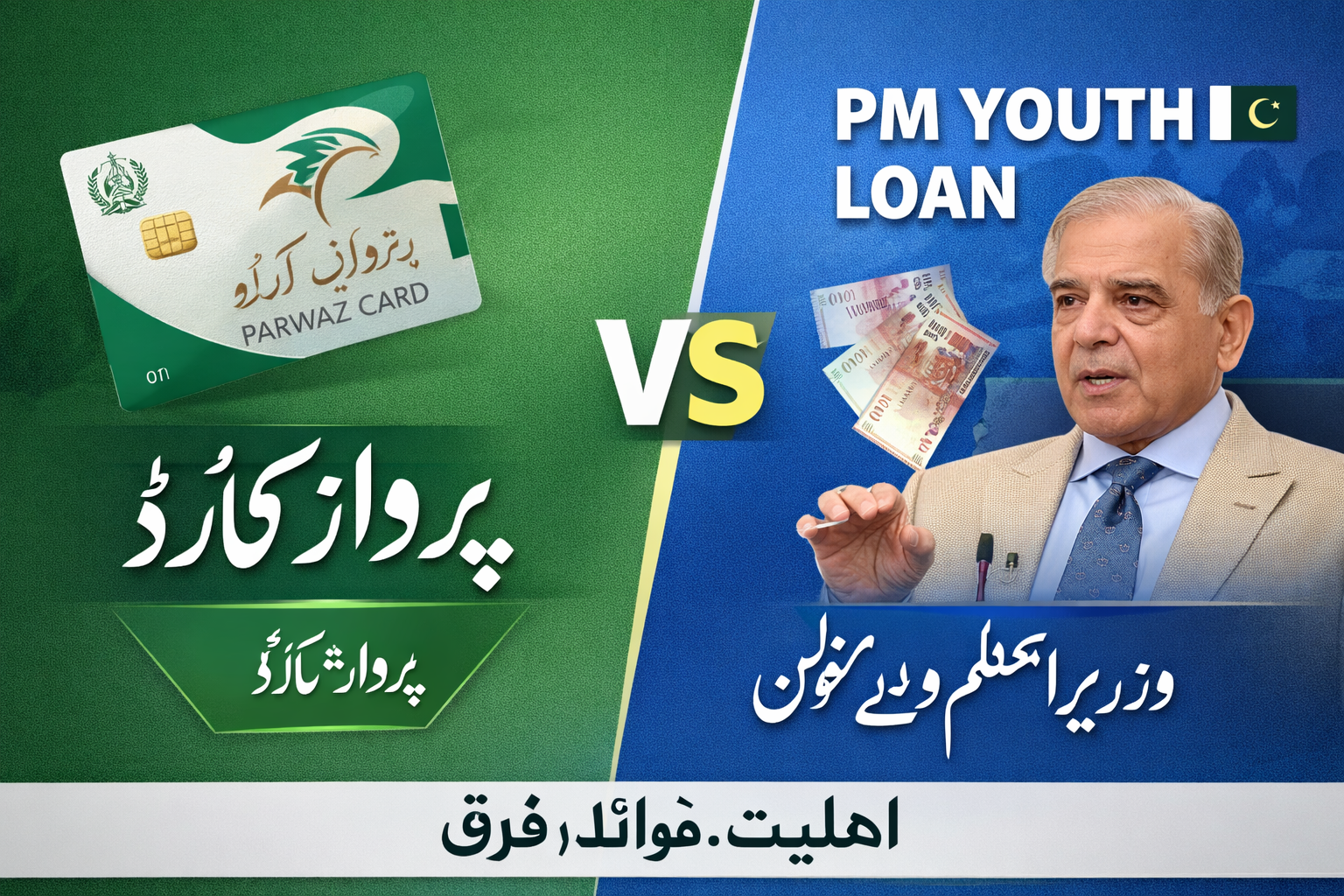
Government schemes in Pakistan often arrive wrapped in hope, fine print, and long queues. Among the most discussed initiatives for youth empowerment are the Parwaz Card Scheme and the Prime Minister’s Youth Loan Scheme (PMYLS). While both target young Pakistanis, their purpose, structure, benefits, and risks are fundamentally different.
This article presents a clear, unbiased, step-by-step comparison of Parwaz Card vs PM Youth Loan to help applicants decide which option actually suits their situation — not which sounds better in headlines.
Overview of Both Schemes
What Is the Parwaz Card Scheme?
The Parwaz Card Scheme, launched by the Punjab Government, is a financial inclusion and support initiative aimed primarily at students and unemployed or low-income youth. It focuses on providing interest-free or subsidized financial assistance, skill development support, and access to opportunities rather than long-term debt.
Its philosophy is simple: help youth stand before asking them to run.
What Is the Prime Minister’s Youth Loan Scheme?
The PM Youth Loan Scheme is a federal-level financing program designed to promote entrepreneurship and self-employment by offering loans through commercial banks.
It provides large loan amounts, but with repayment obligations, banking scrutiny, and risk exposure. It assumes the applicant is ready to run a business — immediately.
Core Difference in Purpose
This is where the two schemes part ways decisively.
- Parwaz Card focuses on:
- Support
- Access
- Capacity building
- Financial inclusion
- PM Youth Loan focuses on:
- Business financing
- Entrepreneurship
- Loan-based growth
- Repayment discipline
One helps you prepare.
The other assumes you already are.
Related Programs
Ehsaas Emergency Cash Past vs New Criteria – What Has Changed?
Eligibility Criteria Comparison
| Criteria | Parwaz Card | PM Youth Loan |
| Age Limit | Usually students & young adults | 21–45 years |
| Education | Students & graduates preferred | Not mandatory |
| Employment Status | Unemployed / students allowed | Repayment capacity required |
| CNIC | Mandatory | Mandatory |
| Credit History | Not required | Mandatory (eCIB check) |
| Gender Preference | Inclusive | Women encouraged |
Key insight:
Applicants rejected by PM Youth Loan often qualify for Parwaz Card — not the other way around.
Financial Nature: Grant vs Loan
Parwaz Card
- Often interest-free
- Small to moderate financial support
- No heavy repayment burden
- Focus on opportunity access rather than profit

PM Youth Loan
- Loan-based
- Subsidized markup, not free money
- Repayment starts after grace period
- Long-term financial obligation
If fear keeps you awake at night, Parwaz Card is kinder.
Loan / Support Amounts
| Aspect | Parwaz Card | PM Youth Loan |
| Amount Range | Limited / controlled | PKR 500,000 – 7.5 million |
| Collateral | Not required | Required for higher tiers |
| Risk Level | Low | Medium to High |
PM Youth Loan offers power, but power demands responsibility. And collateral.
Application Process Comparison
Parwaz Card Application
- Government portal or designated registration drives
- Simple data submission
- CNIC-based verification
- Minimal documentation
- Faster screening
PM Youth Loan Application
- Online + bank processing
- Business plan submission
- Bank interviews
- Credit history check
- Longer approval cycle
One asks who you are.
The other asks who you owe.
Documentation Requirements
Parwaz Card
- CNIC
- Student or basic profile information
- Minimal paperwork
PM Youth Loan
- CNIC
- Business plan
- Income proof
- Bank statements
- Guarantors / collateral (for higher tiers)
Paperwork is the first filter. Many don’t survive it.
Risk & Responsibility
This is the part people avoid discussing.
Parwaz Card Risk
- Very low financial risk
- No aggressive recovery mechanism
- Limited financial exposure
PM Youth Loan Risk
- Bank recovery process
- Legal consequences in default
- Pressure of repayment
- Psychological stress
The loan doesn’t care about your intentions. Only installments.
Target Audience: Who Should Apply?
Parwaz Card Is Better For:
- Students
- Fresh graduates
- Unemployed youth
- Those with no credit history
- Those seeking skill or opportunity support
PM Youth Loan Is Better For:
- Serious entrepreneurs
- Small business owners
- Individuals with clear revenue plans
- Applicants comfortable with debt
- Those who understand banking systems
Applying for the wrong scheme is worse than not applying at all.
Impact on Future Financial Profile
- Parwaz Card:
- Neutral impact
- Does not create debt history
- Safe for beginners
- PM Youth Loan:
- Builds or damages credit history
- Success improves banking trust
- Failure follows you for years
Banks never forget.
Province vs Federal Scope
- Parwaz Card:
- Provincial (Punjab-focused)
- Limited geographical reach
- Easier monitoring
- PM Youth Loan:
- Nationwide
- Uniform policy
- Competitive application pool
Accessibility depends on where you stand — literally.
Common Reasons for Rejection
Parwaz Card
- Not meeting student/youth criteria
- Incorrect CNIC data
- Incomplete profile
PM Youth Loan
- Weak business plan
- Poor credit history
- Low repayment capacity
- Applying for higher tier without strength
PM Youth Loan rejects silently. Parwaz Card usually explains.
Which Scheme Is Better? (Final Comparison Verdict)
There is no universal winner.
- If you are starting out, uncertain, or cautious → Parwaz Card
- If you are prepared, confident, and financially aware → PM Youth Loan
One is a ladder.
The other is a test.
Choose based on your reality — not ambition alone.
Frequently Asked Questions (FAQs)
Q1: Can I apply for both schemes?
Yes, if eligibility criteria allow, but approval is independent.
Q2: Is Parwaz Card available in all provinces?
Primarily Punjab-based.
Q3: Can PM Youth Loan be converted to a grant?
No. It is a loan with repayment obligation.
Q4: Which scheme is safer?
Parwaz Card carries significantly lower financial risk.
Conclusion
The debate of Parwaz Card vs PM Youth Loan is not about which scheme is better — it is about which stage of life you are in. One supports growth without pressure. The other rewards readiness with responsibility.
Choose carefully.
Schemes end. Consequences don’t.